IASM特邀报告:杨灿 Hierarchica...
2026-03-04
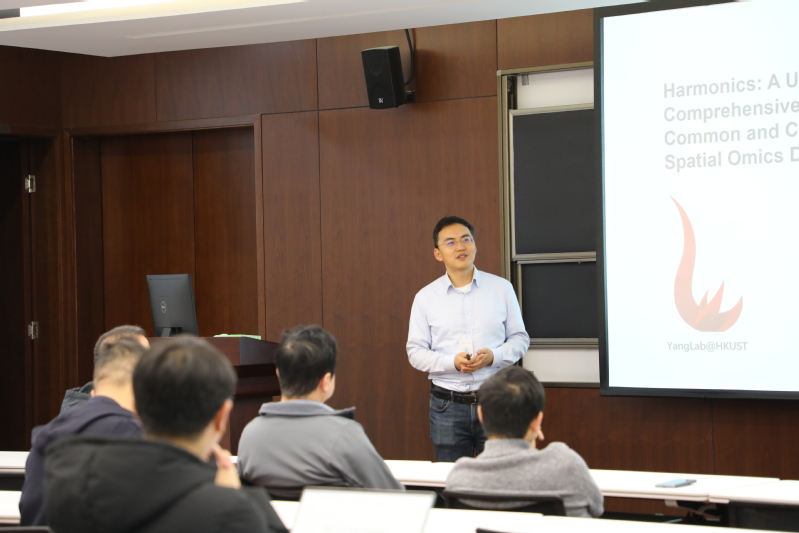
日期: 2026年3月4日地点: 数学高等研究院报告厅报告人:杨灿 Can Yang (香港科技大学)报告1:Hierarchical distribution matching enables comprehensive characterization of common and condition-specific cell niches in spatial omics data时间:10:00 -11:00摘要:Deciphering cell niches in complex tissues is essential for understanding tissue structure and disease. Recent advances in spatial omics have enabled subcellular resolution and accurate cell identity mapping. However, robust delineation of cell niches and disease-associated spatial patterns remains difficult. We introduce Harmonics, a novel computational framework that systematically identifies both common and condition-specific cell niches from spatial omics data through hierarchical distribution matching. Harmonics also includes a suite of downstream modules that facilitate comprehensive niche characterization. We demonstrate its scalability, accuracy and generalizability across datasets spanning diverse species, tissues, diseases, spatial modalities, and technological platforms. For condition-agnostic datasets, Harmonics outperforms baseline methods in both accuracy and robustness, and further demonstrates the capability to resolve niche structures at finer granularity. Across diverse diseases including pulmonary fibrosis, triple-negative breast cancer, and colorectal cancer, Harmonics enables precise identification of condition-specific niches and reveals disease-associated dynamics, subtype-specific spatial patterns, and structured immune architectures. We envision Harmonics as a practical and versatile tool for spatial niche analysis that can be applied across a wide range of biological contexts and seamlessly integrated with existing spatial omics workflows. This is a joint work with our lab members, Yuyao Liu, Jiashun Xiao, Xiaoheng Ma, Xiaomeng Wan, Peiqi Jiang, Zhiwei Wang, and Yuheng Chen.报告2:A statistical framework for identification of cell-type-specific spatially variable genes in spatial transcriptomic studies时间:14:00 -15:00摘要:Characterizing cell-type-specific spatially variable genes (SVGs) within tissue context is essential for exploring the landscape of complex biological systems in spatial transcriptomic (ST) studies. In this paper, we present a statistical framework, the Mixture of Mixed Models (MMM), designed to directly model RNA count data and identify cell-type-specific SVGs while accounting for cell type composition and correcting for platform effects. Through a comprehensive simulation study and the analyses of eight publicly available ST datasets from various tissues and technologies with different resolutions, we demonstrate the effectiveness and robustness of MMM in identifying cell-type-specific SVGs. Notably, our integrative analysis with genome-wide association studies reveals that the cell-type-specific SVGs identified by MMM in a mouse brain study exhibit significant heritability enrichment in brain-related phenotypes. This finding suggests that cell-type-specific SVGs play a vital role in elucidating the mechanisms underlying complex traits and diseases. When applying MMM to analyze a high-resolution Xenium human breast cancer dataset by accounting for the uncertainties in cell segmentation, we find that certain cell-type-specific SVGs may contribute to cell–cell communications, thereby regulating the tissue microenvironment. Furthermore, we show the versatility of MMM by applying it to the 3D tissue models constructed from multiple ST slices, highlighting its utility in analyzing the 3D ST data. This is a joint work with Zhiwei Wang, Yeqin Zeng, Ziyue Tan, Yuheng Chen, Xinrui Huang, Hongyu Zhao, and Zhixiang Lin. https://doi.org/10.1073/pnas.2503952122报告人简介:Prof. Yang Can is currently a Professor in the Department of Mathematics at The Hong Kong University of Science and Technology (HKUST), where he also serves as the Director of the Big Data Bio-Intelligence Lab (BDBI). He holds several editorial positions, including Associate Editor for the Annals of Applied Statistics, Section Editor for PLOS Computational Biology, and Associate Editor for Genetics and Human Genetics and Genomics Advances. His research specializes in data science, focusing on the development of novel statistical and computational methods for large-scale data analysis, including deep generative models and scalable AI algorithms. Prof. Yang's work has been published in high-impact journals and at prestigious machine learning conferences, including Nature, Nature Machine Intelligence, Nature Computational Science, Nature Communications, Proceedings of the National Academy of Sciences (PNAS), Annals of Statistics, IEEE Transactions on Pattern Analysis and Machine Intelligence, The American Journal of Human Genetics, and the International Conference on Machine Learning. Prof. Yang has also fostered industrial collaborations supported by the Innovation and Technology Fund of the Hong Kong Government.





 Jonathan Trejos(南方科技大学)
 海纳苑2幢204室